
Many traders treat “login” as a trivial step between coffee and charts. That’s the misconception. On OKX the login process is tightly coupled to custody, risk controls, and functional access: how you authenticate determines whether you can trade margin, use the Web3 wallet, or recover assets after a device loss. This article explains how OKX’s login and wallet systems work, what that means for spot trading behavior in the US, and the practical trade-offs between convenience and security.
We’ll move from mechanism to decision: first how OKX authenticates and segments access, then how that affects spot trading and wallet choices, then where systems break down in practice and what to monitor next. Expect at least one non-obvious distinction — between centralized account credentials and self-custodial wallet recovery — and a usable framework for making daily operational choices.
How OKX login works: layers, incentives, and friction
OKX uses a layered authentication model. At the outer layer is your primary account login: email or phone plus password. That unlocks the centralized exchange (CEX) dashboard where spot, margin, derivatives, staking, and the NFT marketplace sit. On top of that, mandatory identity verification (KYC) unlocks fiat rails, higher withdrawal limits, and US-compliant activity. A second, mandatory layer — Two-Factor Authentication (2FA) — adds a real-time confirmation step using SMS, Google Authenticator, or biometrics (on mobile devices).
This architecture creates predictable trade-offs. Stronger authentication reduces account takeover risk (important because CEX accounts control custodial balances), but it also increases recovery friction if you lose access to 2FA devices or fail a facial liveness check. For US users, the KYC requirement is not optional if you want bank-linked deposits and larger trading limits. Mechanistically, KYC binds identity to on-chain activity only at the exchange layer — it does not change the technical rules of blockchains or the self-custodial wallet side.
Spot trading on OKX: what login status unlocks and what it hides
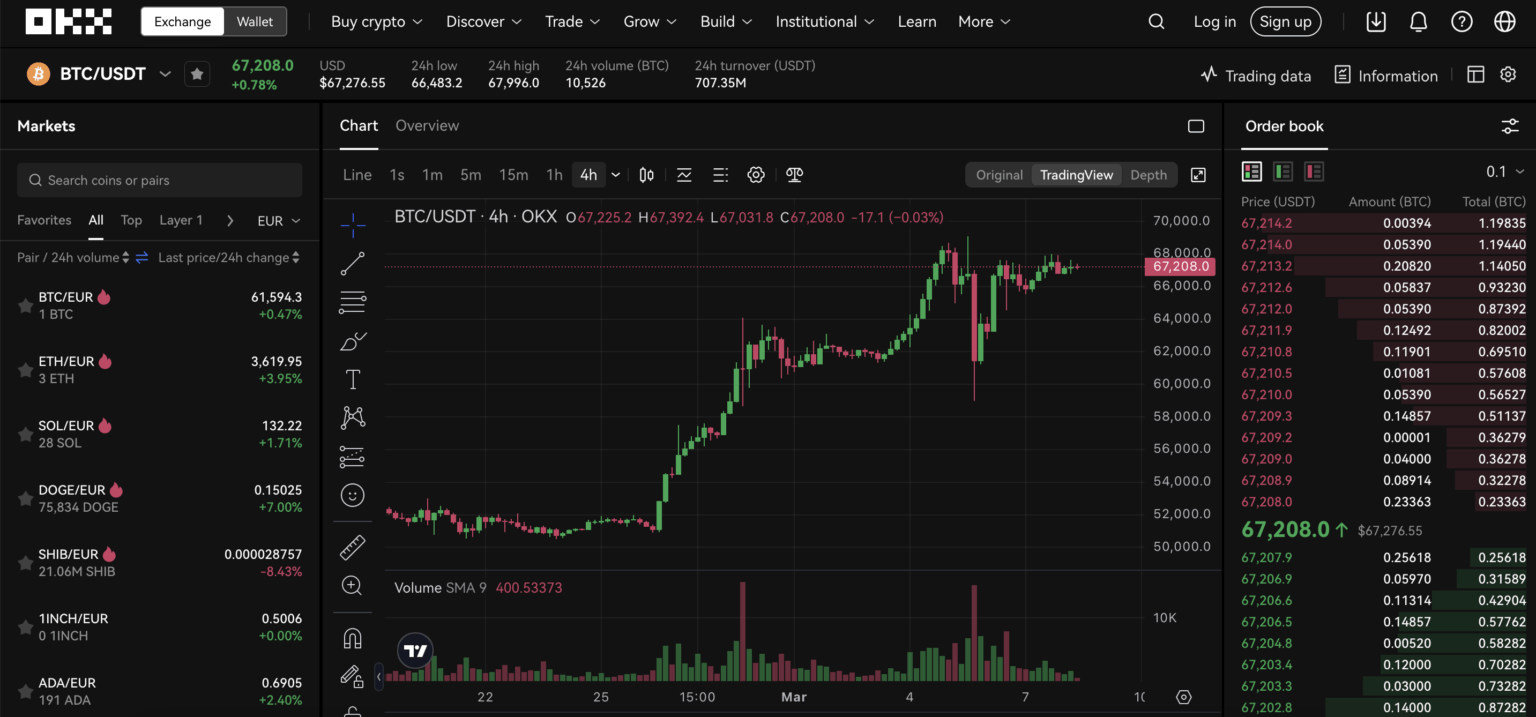
Spot trading — buying and selling at market prices — is the simplest product but still sensitive to login state. With a fully verified account and active 2FA you get access to limit and market orders, tradingView charting, and margin options (up to 10x leverage in isolated or cross-margin modes). Without proper authentication, you may be limited to read-only views or low-volume trading. That matters during volatile moves: if you can’t log in quickly because of a 2FA outage, you can’t cancel orders or shift between spot and margin.
One practical implication: treat your login stack as part of your execution infrastructure. Many traders separate devices — a secure phone for 2FA and a workstation for charts — to reduce single-point failures. But remember the trade-off: more devices and recovery paths mean a larger attack surface. For high-frequency or event-driven traders, test logins and recovery steps during calm markets. A rehearsal reveals hidden dependencies: does your SMS provider work abroad? Does your biometric device retain access after an OS update?
OKX wallet: custodial vs non-custodial and how login ties them together
OKX operates both custodial accounts and a non-custodial Web3 wallet. The custodial side is governed by the exchange’s login and KYC systems; the exchange holds assets with over 95% in multi-signature cold storage, meaning withdrawals require approvals and use air-gapped keys. The non-custodial wallet, by contrast, is a local seed-phrase model: you control private keys, can connect hardware wallets like Ledger/Trezor, and interact with DApps directly. Your exchange login does not control a non-custodial wallet — it simply acts as a convenience bridge when you connect the wallet to the platform.
That distinction is critical. If you lose your exchange credentials but your funds are custodial on OKX, there are recovery paths tied to KYC and the exchange’s support processes. If you lose a seed phrase for the non-custodial wallet, there is no central recovery — permanent loss is possible. So the mental model is: custodial + login = regulated recovery but counterparty risk; non-custodial + seed phrase = no counterparty risk but irrecoverable if you lose keys.
Common myths vs reality
Myth: Using biometrics on a phone makes an account invulnerable. Reality: biometrics ease login and reduce phishing, but they are an authentication factor on a device; if that device is compromised or the biometric database is cloned, you still risk theft. Also, biometrics don’t replace the need for strong password hygiene and secondary 2FA.
Myth: Self-custody always beats custodial services. Reality: self-custody eliminates counterparty insolvency risk but increases operational risk (seed loss, user error, smart contract exploits). Many serious traders pair approaches: keep an execution balance on CEX for active spot trading and maintain cold or hardware-held reserves in self-custodial wallets for long-term holdings.
Where the system breaks: friction points and real risks
Several operational failure modes matter in practice. First, KYC frictions: facial recognition failures or mismatched ID data can block access during crucial periods. Second, delisting and liquidity changes: exchanges periodically delist pairs (recently OKX removed several low-volume spot pairs), which can trap positions or force manual swaps — another reason to avoid putting large fractions of capital into ultra-low-liquidity tokens if you rely on the exchange for execution. Third, phishing and credential harvesting: AI-driven phishing is improving, so a single successful social-engineering attack can bypass password protections if 2FA is poorly configured (e.g., SMS-only). Finally, DeFi interface risks: connecting your Web3 wallet to a malicious DApp can drain self-custodial balances even when your exchange account remains secure.
Limitation to emphasize: Proof of Reserves provides on-chain evidence that holdings are backed, but it does not prevent operational failures or human mistakes; it shows solvency, not the absence of fraud, nor does it substitute for individual security hygiene.
Decision framework: a simple heuristic for US traders
Use this three-box heuristic to decide where to place assets and how to structure login tools: 1) Short-term execution (active spot trades): keep a modest balance on OKX custodial account, ensure full KYC and hardware-authenticated 2FA, and rehearse recovery. 2) Medium-term yield (staking, DeFi): prefer locked staking or vetted DeFi strategies, but keep only the amount you can quickly migrate if a delisting or market shock occurs. 3) Long-term reserve (HODL): use non-custodial wallets with hardware seed backups stored offline in multiple secure locations.
This framework forces trade-offs: liquidity vs safety, convenience vs absolute control. For example, moving large sums into self-custody reduces counterparty exposure but increases the need for secure multi-location seed backups — an often-underappreciated operational cost.
What to watch next (conditional signals, not predictions)
Monitor three conditional signals that change operational choices: regulatory shifts affecting US KYC/withdrawal limits (which alter custodial convenience), frequency of delistings or liquidity withdrawals for smaller tokens (which raises execution risk on spot markets), and changes in multi-sig/cold-storage protocols that would materially affect withdrawal latency. If proof-of-reserves transparency increases across exchanges, traders may place more trust in custodial solvency; if phishing incidents rise, prioritize self-custodial or hardware-backed login options.
If you want a short, practical walkthrough for the OKX web login and recovery flow, this guide is a compact resource: https://sites.google.com/cryptowalletextensionus.com/okx-login-web/
FAQ
Q: If I enable biometrics on the OKX mobile app, can I disable 2FA?
A: No. Biometrics is an authentication convenience on your device but OKX enforces 2FA as an additional security layer. Think of biometrics as “what you are” on a device and 2FA as “what you have” or “what you know.” Removing 2FA generally reduces security and may not be permitted for certain account levels or withdrawal thresholds in the US.
Q: Should I move all my spot holdings off OKX into a self-custodial wallet?
A: Not necessarily. The right split depends on priorities. Keep execution capital on OKX if you trade frequently and require fast market access; move long-term holdings to hardware-backed self-custody if you prioritize control and are comfortable with operational key management. A balanced approach preserves liquidity while mitigating counterparty concentration risk.
Q: What happens to my access during a delisting of a spot pair?
A: Delisting removes an order book for specific pairs. You can usually trade into a common base (like USDC or BTC) before the pair is removed, but liquidity may be reduced and spreads widen. If you hold tokens that are delisted, check withdrawal options or swap routes; in some cases you may need to move assets to a different venue or use the OKX DEX aggregator for cross-chain swaps.
Q: How does Proof of Reserves affect my trust in OKX?
A: Proof of Reserves increases transparency about solvency by showing on-chain backing for custodial assets. It is a strong signal of liquidity but does not eliminate operational risks like phishing, smart-contract bugs, or user key loss. Treat PoR as one factor in a broader risk assessment, not a full replacement for personal security practices.
Final takeaway: don’t treat login as a checkbox. For US-based traders, the combination of KYC, 2FA, and custody choice shapes not just security but viable strategies for spot trading, staking, and cross-chain activity. Make those choices explicit, test recovery paths, and match the custody model to your trading tempo and risk tolerance.

